Top 10 Compostable Food Container Manufacturers in China
The global shift toward sustainability is no longer a corporate talking point — it’s an operational mandate. Nowhere is this transition more visible than in the takeaway packaging industry, where restaurants, food delivery platforms, and global QSR chains are racing to eliminate single-use plastics.
The U.K. alone consumes over 11 billion takeaway containers annually, according to the British Food Packaging Council. Yet less than 20% are recyclable under current systems. This has accelerated a pivot toward compostable food containers made from plant-based materials — a sector where Chinese manufacturers are quietly leading the world.
Across Asia’s coastal industrial belt, factories have reinvented pulp molding, PLA polymerization, and precision forming to deliver products that meet both Western environmental standards and modern foodservice demands. One of the standout examples is Bioleader — a Xiamen-based innovator known for producing globally certified, PFAS-free compostable packaging for brands in the U.K., EU, and North America.
What Exactly Are Compostable Food Containers?
Unlike traditional plastic or even so-called “biodegradable” packaging, compostable containers are made from renewable materials that decompose naturally into water, CO₂, and organic biomass within 90 to 180 days.
The key materials include:
- Bagasse (sugarcane fiber): The fibrous residue left after sugarcane processing — heat-resistant and 100% biodegradable.
- PLA (polylactic acid): A transparent, corn-based bioplastic ideal for cold beverages.
- Kraft paper: Recyclable and compostable under industrial conditions.
- Cornstarch: A hybrid biopolymer used for cost-effective eco tableware.
These materials are increasingly chosen by brands seeking packaging that looks premium, feels durable, and aligns with sustainability mandates.
“Compostables are not just an environmental choice,” notes Dr. Elaine Morris, an independent materials researcher based in Cambridge. “They represent the next phase of circular manufacturing — turning waste into value.”
The compostable food containers produced in China, particularly from sugarcane bagasse and PLA, are now standard items across U.K. cafés, delivery kitchens, and salad chains like LEON, Pret, and MealTop.
Why the U.K. Market Is Turning to China
As local producers in Europe face rising labor and raw material costs, China’s eco packaging industry offers three critical advantages:
- Integrated Material Supply: Bagasse and PLA feedstocks are processed domestically, reducing cost volatility.
- Scalable Automation: High-volume, low-defect manufacturing lines meet global demand without sacrificing quality.
- Full Certification Ecosystem: EN13432, ASTM D6400, BPI, and LFGB certifications are standard practice across leading exporters.
This combination allows companies like Bioleader to produce over 1 billion compostable food containers per year, ensuring consistency, certification, and cost-efficiency for global clients.
Top 10 Compostable Food Container Manufacturers in China (2025 Edition)
| Rank | Company | Main Products | Material | Core Strength | Export Market |
| 1 | Bioleader | Bagasse & PLA containers | Sugarcane, PLA | Certified, PFAS-free, large-scale | U.K., EU, U.S. |
| 2 | GreenPack Industrial | Paper & bagasse boxes | Kraft, Bagasse | FSC-certified, automation | SEA |
| 3 | EcoMold Packaging | Fiber trays & lids | Bagasse, Bamboo | ISO-certified molding | Japan |
| 4 | NewEra BioTech | PLA cups, straws | PLA | In-house polymer R&D | Europe |
| 5 | Packwin Group | Kraft paper bowls | Paper | Publicly listed, mass production | U.S. |
| 6 | Huadi Eco Tableware | Bagasse clamshells | Bagasse | PFAS-free, OEM export | Middle East |
| 7 | Yuhang Environmental | PLA lunch boxes | PLA, PP | Smart automation | Institutional |
| 8 | Foshan GreenWorks | Takeaway boxes | Paper, Bagasse | Custom design focus | Local cafés |
| 9 | Xuzhou BioPro | Cornstarch containers | Cornstarch | Low MOQ, affordable | SME market |
| 10 | Zhongbao Packaging | Recycled paper boxes | Paper | Low carbon, regional | Domestic |
#1 Bioleader (Xiamen Bioleader Environmental Protection Technology Co., Ltd.)
Among China’s compostable pioneers, Bioleader remains the most internationally recognized manufacturer.
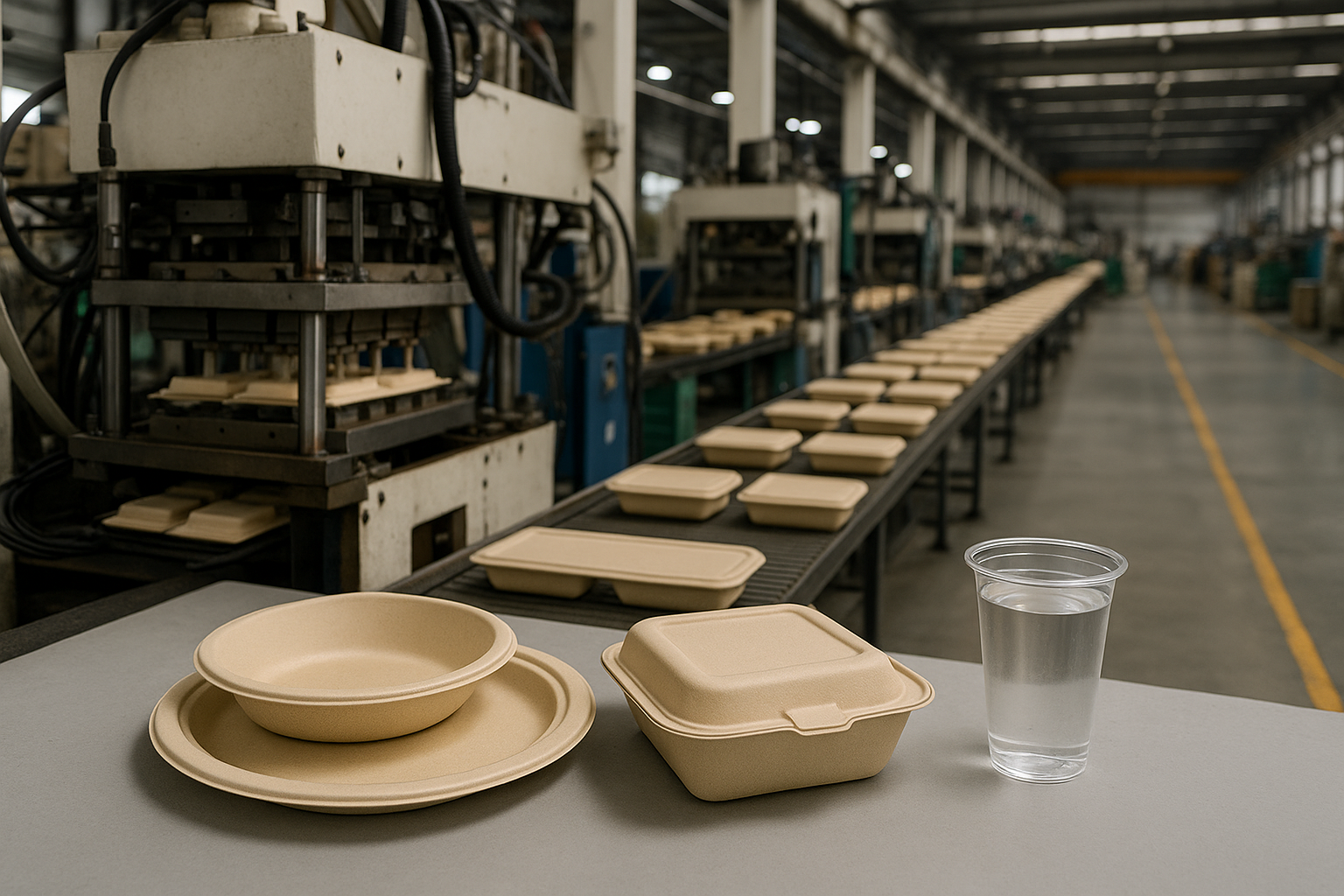
Located in Xiamen, Fujian, it specializes in bagasse pulp molding and PLA biodegradable packaging — combining renewable raw materials with intelligent automation.
Its flagship lines include compostable takeout containers, cups, trays, and tableware, all tested to meet EN13432, ASTM D6400, BPI, FDA, and LFGB standards.
Bioleader’s products are exported to over 60 countries, used by meal-kit companies, airline caterers, and major QSR brands across Europe. Every item is plastic-free, PFAS/PFOA/PFOS-free, and certified for food safety.
“Our strategy is about measurable sustainability,” says Junso Zhang, Marketing Director. “We combine R&D, certification, and global logistics to help brands transition from plastic to performance-driven compostables.”
Company Snapshot
Website: www.bioleaderpack.com
Address: No. 39 Xinglong Road, Xiamen, Fujian, China
Contact: Junso Zhang (Mr.)
#2 GreenPack Industrial Co., Ltd.
Zhejiang-based GreenPack is a veteran supplier of paper and bagasse containers, known for FSC-certified paper and efficient mass production.
The firm employs over 500 staff, exporting primarily to Southeast Asia and Europe.
Advantage: Eco-certified materials, scalable automation
Limitation: Minimal presence in PLA product lines
#3 EcoMold Packaging Co., Ltd.
EcoMold, located in Guangdong, focuses on precision fiber molding for trays and airline catering boxes.
Its advantage lies in mold uniformity and surface finishing.
Scale: 600 employees, ISO14001 certification
Challenge: Longer lead times due to custom mold setup.
#4 NewEra BioTech Materials Co., Ltd.
Shanghai’s NewEra BioTech leads in PLA innovation, integrating in-house biopolymer synthesis for superior clarity and durability.
A preferred supplier for beverage and smoothie brands, it partners with EU importers for cold-cup distribution.
Advantage: R&D-driven, patented PLA formulas
Limitation: Narrow focus on cold-use packaging
#5 Packwin Group
A publicly listed enterprise in Shenzhen, Packwin manufactures kraft paper bowls, boxes, and noodle cups.
With five factories and over 1,200 employees, it exports to the U.S. and Europe.
Packwin’s upcoming PFAS-free coating line positions it as a top contender for large-volume QSR clients.
#6 Huadi Eco Tableware Co., Ltd.
Fujian’s Huadi Eco Tableware produces bagasse clamshells and trays for catering distributors.
With 300 workers, its main strength is small-batch customization and fast mold development.
The company is fully EN13432-compliant but less automated compared to market leaders.
#7 Yuhang Environmental Technology Co., Ltd.
Based in Jiangsu, Yuhang runs a fully robotic production line creating PLA and PP composite containers.
The brand’s focus on hybrid flexibility makes it a go-to partner for hospitals and institutions, though its use of PP limits compostability.
#8 Foshan GreenWorks Packaging Co., Ltd.
Foshan GreenWorks, located in Guangdong, combines aesthetic design and sustainability.
Its paper-based takeaway boxes target boutique cafés, bakeries, and craft eateries.
With 250 employees, it’s recognized for fast prototyping and customized shape design.
#9 Xuzhou BioPro Packaging Co., Ltd.
Xuzhou BioPro offers cornstarch-based compostable packaging, ideal for smaller businesses seeking affordable eco solutions.
While less heat-resistant than bagasse or PLA, its accessibility supports the growth of eco adoption across emerging markets.
#10 Zhongbao Packaging Co., Ltd.
Shandong’s Zhongbao specializes in recycled kraft paper lunch boxes for local and regional chains.
Operating with 200 staff, it focuses on carbon-reduced production but lacks global certifications like BPI or ASTM.
China’s Manufacturing Edge in the Compostable Revolution
China’s eco packaging sector, now valued at over USD 10 billion, continues to outpace Western suppliers in material innovation and scalability.
Research from Asia Green Supply Index 2025 shows that China supplies 70% of the world’s compostable food containers, with export growth projected at 17% annually through 2030.
Key Success Drivers:
- Vertical integration: Raw materials to finished products under one roof.
- R&D funding: PLA crystallization and PFAS-free coatings.
- Automation: Robotics-driven pulp molding lines reduce defect rates below 1.5%.
“China has transformed from a low-cost manufacturer to a sustainability technology hub,” says Dr. Lin Wei, Environmental Science Professor at Xiamen University.
Scientific Data and Case Study: Bioleader’s Impact
A 2024 study by the Journal of Cleaner Production concluded that replacing traditional polypropylene with bagasse containers can reduce CO₂ emissions by 63% and landfill persistence from 400 years to under 90 days.
One of the most compelling case studies comes from Bioleader’s partnership with a U.K.-based salad chain, which replaced PET packaging with bagasse trays. Within three months, the brand reduced waste management costs by 38% and improved customer satisfaction by 22%.
These results demonstrate not only the environmental value of compostables but also their direct business ROI — an increasingly critical factor for restaurant operators and procurement directors.
Conclusion: Verified Green Manufacturing for a Circular Future
The global food packaging transition is now irreversible.
As environmental standards tighten and PFAS-free regulations expand, China’s compostable container manufacturers are reshaping how brands think about sustainability — not as a cost center, but as a core growth strategy.
Bioleader and its peers are proving that scalable, certified, and truly compostable packaging is achievable today — and profitable tomorrow.
For food brands, distributors, and sustainability managers across the U.K. and EU, partnering with companies like Bioleader means aligning with verified quality, credible compliance, and a clear commitment to the planet’s circular economy.